
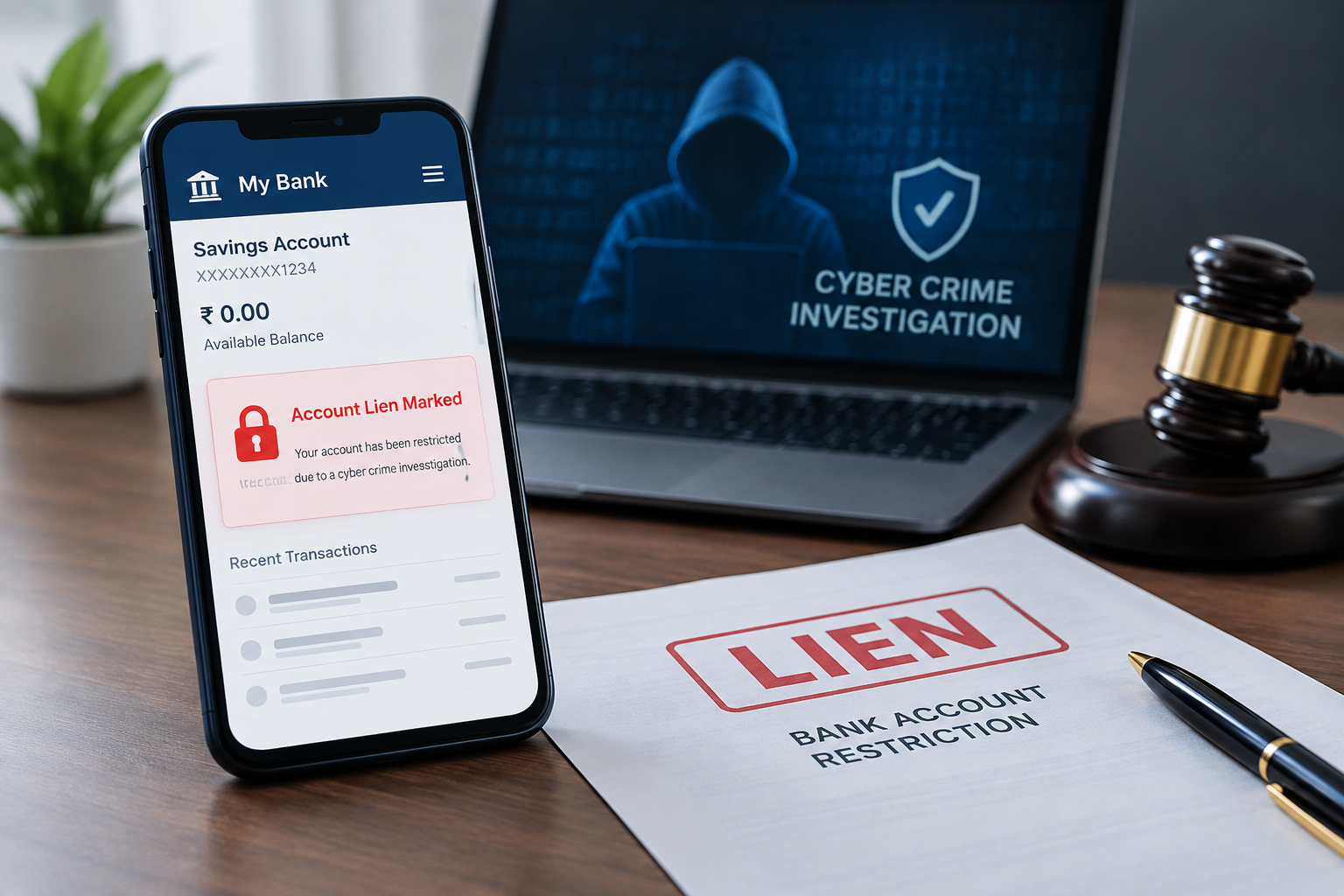
A bank account lien marked by a cyber cell can be confusing and stressful, particularly when the account holder has not knowingly participated in any cybercrime. A lien or restriction may prevent a person from withdrawing or transferring certain funds while a cybercrime investigation is underway.
Cybercrime-related account restrictions can arise when money linked to a reported fraud moves through a bank account or when investigators identify a financial connection that requires further examination. The Indian Cyber Crime Coordination Centre (I4C) has clarified that it does not itself freeze or lien-mark bank accounts. Such action may be taken by the concerned law-enforcement agency during an investigation or by banks under applicable regulatory requirements.
Understanding why an account is lien marked and what legal steps are available can help account holders respond appropriately.
What Does a Bank Account Lien Mean?
A bank account lien generally means that a specified amount or portion of the funds in an account is placed under restriction. Depending on the circumstances, the account may continue to operate for some transactions while the identified amount remains blocked.
A lien should not automatically be treated as a finding that the account holder committed a crime. In cybercrime investigations, an account can become connected to a disputed transaction even when the account holder claims to be unaware of the underlying fraud.
The exact effect of the restriction depends on the instructions received by the bank and the circumstances of the investigation.
Why Is a Bank Account Lien Marked by a Cyber Cell?
There can be several reasons for a cybercrime-related lien or freeze, including:
1. Suspected Fraudulent Transaction
If money reported as proceeds of an online fraud is transferred into an account, investigators may examine that account as part of tracing the funds.
2. Money Trail Investigation
Cybercrime investigations often involve following the movement of money through multiple bank accounts. An account may therefore come under investigation because a transaction connected to the alleged fraud passed through it.
3. Mule Account Concerns
Accounts used to receive or transfer funds on behalf of other people can attract investigation. The Reserve Bank of India has warned customers against allowing unknown persons to use their bank accounts for transferring funds because such arrangements can expose account holders to serious legal risks.
4. Complaint Related to Online Financial Fraud
When a victim reports financial cyber fraud, law-enforcement authorities may coordinate with banks and financial intermediaries to restrict movement of the disputed funds. The National Cyber Crime Reporting Portal provides a mechanism for reporting such complaints.
What Is the Difference Between a Lien and a Complete Account Freeze?
A lien may relate to a particular amount that has been placed under restriction, whereas a full account freeze can restrict broader account operations.
However, the terminology used by banks may vary depending on the instruction received and the circumstances of the case. Therefore, an account holder should ask the bank for written information explaining the nature and extent of the restriction.
Knowing whether the restriction concerns a specific amount or the entire account is important when deciding the appropriate next step.
What Should You Do If Your Account Is Lien Marked?
If you discover that your bank account has been lien marked due to a cybercrime investigation, consider taking the following steps:
1. Contact Your Bank
Ask the bank for information about the restriction, including the amount under lien, the date it was imposed, and the authority or investigating agency that issued the instruction.
2. Identify the Relevant Cybercrime Complaint
Find out whether the restriction relates to a particular transaction, complaint, FIR, or investigation. Keep copies of relevant communications provided by the bank.
3. Collect Supporting Documents
Prepare documents that can establish the legitimate source and purpose of the funds. Depending on the transaction, these may include bank statements, invoices, payment records, agreements, UPI transaction details, communication records, and other relevant evidence.
The National Cyber Crime Reporting Portal also advises complainants to preserve evidence such as bank statements, online transfer receipts, emails, URLs, chat records, screenshots, videos, and other relevant documents.
4. Respond to the Investigating Authority
If contacted by the cybercrime police or investigating officer, provide accurate information and supporting documents. Do not ignore official communications.
5. Seek Legal Assistance
If the account has been restricted despite legitimate transactions or if the restriction continues without resolution, a lawyer can examine the circumstances and advise on the appropriate legal remedy.
Can a Lien Mark Be Removed?
A lien or freeze may be removed when the concerned authority or institution determines that the restriction is no longer required, subject to the circumstances and applicable law.
The process can depend on why the account was restricted, whether an investigation is pending, the amount involved, and the instructions issued to the bank.
If you believe your account has been wrongly connected with a cybercrime, legal representation may help you present documents establishing the legitimate nature of the transactions and seek appropriate relief.
Can You File a Cyber Crime Complaint?
If you are the victim of cyber financial fraud, you should report it promptly through the National Cyber Crime Reporting Portal or the cybercrime helpline 1930. The official portal states that complaints are handled by the relevant State or Union Territory law-enforcement authorities.
When reporting financial fraud, keep important transaction information ready, including the bank or wallet details, transaction/UTR number, transaction date, fraud amount, and supporting evidence.
Common Mistakes to Avoid
If your bank account has been lien marked, avoid:
Ignoring communications from the bank or investigating agency
Deleting transaction records or messages
Providing false information
Allowing another person to operate your bank account
Making unexplained transfers from other accounts
Assuming that a lien automatically means you have been accused or convicted of an offence
Providing accurate information and maintaining proper financial records can make it easier to explain legitimate transactions.
How Can a Lawyer Help?
A lawyer can review the circumstances behind the bank account lien, examine the available documents, communicate with the relevant authorities where appropriate, and advise the account holder regarding available legal remedies.
Where a person believes that a restriction has been incorrectly imposed or that legitimate funds have been affected, obtaining legal advice can help determine the appropriate course of action based on the facts of the case.
Conclusion
A bank account lien marked by a cyber cell does not necessarily mean that the account holder is guilty of cybercrime. An account may become part of an investigation because of a transaction or money trail connected to a reported cyber fraud.
If your account is lien marked, first understand the nature and reason for the restriction, obtain relevant information from your bank, preserve supporting documents, cooperate with legitimate investigative requests, and seek legal advice where necessary.
For victims of cyber financial fraud, prompt reporting through the National Cyber Crime Reporting Portal or 1930 can help initiate the appropriate process.
Frequently Asked Questions
1. What does a cyber cell lien on a bank account mean?
It generally means that an amount or funds in the account have been placed under restriction in connection with an investigation or other lawful instruction.
2. Can my bank account be lien marked because of someone else's fraud?
An account may come under investigation if transactions connected with an alleged fraud have passed through it. The circumstances should be examined individually.
3. How can I find out why my account was frozen?
Contact your bank and ask for details of the restriction, including the relevant authority, reference information, and amount affected.
4. Can a lawyer help remove a cybercrime-related lien?
A lawyer can review the facts and documents and advise on the appropriate legal process for seeking relief or removal of the restriction.
5. What is the cybercrime helpline number in India?
The National Cyber Crime Reporting Portal lists 1930 as the cybercrime helpline, including for reporting financial cyber fraud.
Disclaimer: This article is intended for general informational purposes and does not constitute legal advice. The appropriate legal remedy depends on the facts and circumstances of each case.