
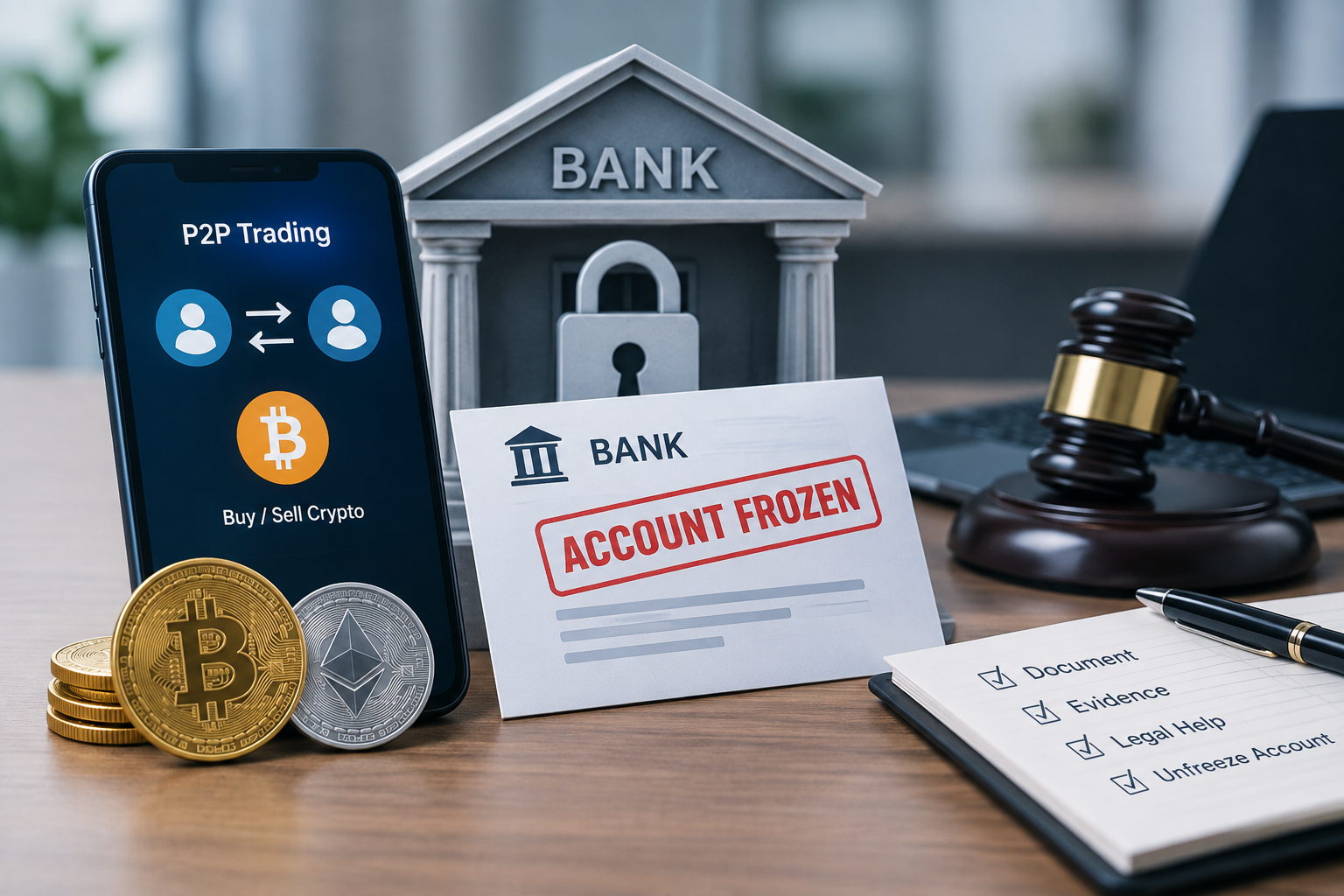
Cryptocurrency peer-to-peer (P2P) trading has become increasingly common in India, particularly for transactions involving assets such as Bitcoin and USDT. However, P2P traders can sometimes face an unexpected problem: their bank account may be frozen, placed under a lien, or restricted after receiving money from a crypto transaction.
For a genuine trader, this situation can be particularly stressful. The account holder may have completed a legitimate transaction but later discover that the money received was allegedly connected to a cybercrime complaint or fraudulent transaction.
A bank account freeze does not necessarily mean that the account holder is guilty of a crime. Depending on the circumstances, a genuine trader may have legal options to establish the source of funds and seek appropriate relief.
Why Can a Crypto P2P Bank Account Be Frozen?
A bank account involved in a crypto P2P transaction may come under scrutiny when a payment received into the account is reported as part of a suspected fraud.
For example, a trader may sell USDT to another person through a P2P platform. The buyer transfers Indian rupees to the seller's bank account. Later, the buyer or another person involved in the payment chain reports a cybercrime.
The investigating authorities may trace the disputed funds through different bank accounts. As a result, an innocent account holder who received the money during a legitimate P2P transaction can become connected to the investigation.
Possible reasons for restrictions can include:
A cybercrime complaint involving the transaction
Suspicious or disputed fund transfers
A payment originating from a fraud victim
Unusual transaction patterns
KYC or source-of-funds concerns
A request from investigating authorities
A suspected money trail connected with an ongoing investigation
The exact legal basis and procedure can vary depending on the facts of the case and the authority involved.
Does a Bank Freeze Mean the Crypto Trader Is Guilty?
No. A bank account restriction or freeze should not automatically be treated as proof that the account holder committed fraud.
In a P2P transaction, funds can pass through several accounts. A person may receive money from a buyer without knowing that the buyer obtained those funds through an unrelated fraudulent activity.
The key issue is often whether the trader can demonstrate a genuine and traceable transaction.
This is why maintaining proper records is extremely important for anyone regularly participating in crypto P2P transactions.
What Evidence Should Genuine P2P Traders Preserve?
If your bank account has been frozen because of a crypto-related transaction, documentation can become extremely important.
A trader should preserve relevant evidence such as:
P2P order or trade ID
Cryptocurrency exchange records
Transaction date and time
Bank statement showing the incoming payment
UTR or transaction reference number
Screenshots of the P2P order
Buyer and seller communication
Wallet transaction hash
Cryptocurrency deposit and withdrawal records
KYC details submitted to the exchange
Proof showing the source and nature of the transaction
Income-tax records or other relevant financial documentation, where applicable
Do not delete chats, transaction records, emails, or exchange information simply because the transaction has already been completed.
A clear transaction trail can help demonstrate that the crypto sale was genuine and that the account holder was not knowingly participating in fraudulent activity.
What Should You Do If Your Bank Account Is Frozen?
The first step is to understand why the account has been restricted.
Contact the bank and request information about the nature of the restriction. Depending on the circumstances, the bank may be able to indicate whether the restriction relates to a law-enforcement request, cybercrime investigation, lien, or another compliance issue.
The account holder should avoid making assumptions about the reason for the freeze.
Next, collect all documents relating to the relevant P2P transaction. Organize them chronologically so that the transaction can be explained clearly.
If a cybercrime investigation is involved, legal assistance can be useful in communicating with the relevant authority and presenting evidence establishing the legitimate nature of the transaction.
Can You Request the Bank Account to Be Unfrozen?
Yes, depending on the circumstances, a person whose account has been restricted may seek appropriate relief.
The appropriate course of action depends on factors such as:
The reason for the freeze
The authority requesting the restriction
The amount under dispute
Whether the account holder is named as an accused or is only part of the money trail
The available transaction records
The stage of the investigation
In some situations, representations can be made to the investigating authority with supporting documents. In appropriate cases, legal remedies before the competent court may also be considered.
A lawyer can examine the underlying complaint, transaction trail, bank communication, and investigation details before determining the appropriate remedy.
What If Only a Particular Amount Is Disputed?
A P2P trader may sometimes find that the issue concerns a particular transaction or amount rather than the entire balance in the account.
The distinction can be legally important.
Where the dispute relates to specific funds, the trader should obtain professional advice on whether the restriction can be challenged or whether appropriate relief can be sought concerning the unaffected funds.
The exact remedy will depend on the circumstances and the orders or directions underlying the restriction.
Why P2P Traders Should Maintain a Clear Transaction Trail
Crypto P2P trading involves transactions between individuals, which can make documentation particularly important.
A trader should preferably use reputable platforms, complete required KYC procedures, maintain accurate records, and avoid accepting unexplained third-party payments.
It is also advisable to maintain records showing:
Crypto sold → P2P order → buyer → payment received → bank transaction → crypto transfer.
This chain can help explain the transaction if questions are later raised about the source of funds.
Can a Lawyer Help With a Crypto-Related Bank Freeze?
Yes. A lawyer experienced in cybercrime, cryptocurrency disputes, banking matters, and financial investigations can review the circumstances and identify potential legal remedies.
The lawyer may examine the transaction history, bank records, P2P order, cybercrime complaint, and communications from authorities.
Depending on the facts, possible steps may include making a representation to the relevant authority, seeking clarification regarding the disputed transaction, requesting appropriate relief, or approaching the competent court.
Importantly, every case is fact-specific. There is no single procedure that automatically applies to every crypto P2P bank freeze.
Conclusion
A crypto P2P bank account freeze in India can create serious financial difficulties, particularly when the account holder is a genuine trader who had no knowledge of any alleged fraud connected with the funds.
However, an account restriction should not be assumed to establish criminal liability. Maintaining complete records and establishing a clear transaction trail can be crucial when responding to questions about a P2P transaction.
If your bank account has been frozen following a crypto P2P transaction, obtain the relevant bank and transaction information, preserve your evidence, and seek appropriate legal advice before taking further action.
This article is intended for general informational purposes and does not constitute legal advice. Cryptocurrency regulations, banking procedures, and investigative practices may change, and the appropriate remedy depends on the facts and circumstances of each case.