
Introduction
In today’s digital world, a single social media post, online review, YouTube video, or public statement can seriously damage a person’s reputation. Indian law provides legal remedies against false and harmful statements through defamation laws. However, many people are confused about the difference between criminal defamation and civil defamation in India.
Understanding these legal concepts is important for individuals, businesses, influencers, professionals, and organizations facing reputational harm. This guide explains how defamation law works in India, the difference between civil and criminal defamation, available legal remedies, and when you should seek legal assistance.
What Is Defamation Under Indian Law?
Defamation refers to any false statement made about a person or organization that harms their reputation in society. In India, defamation can arise through spoken words, written content, online posts, videos, news publications, emails, or social media messages.
A statement may amount to defamation if:
It is false or misleading
It harms a person’s reputation
It is communicated to a third party
It causes mental, social, or financial damage
Indian law recognizes two major types of defamation:
Criminal Defamation
Civil Defamation
Both have different legal procedures and consequences.
Criminal Defamation in India
Criminal defamation is governed by Sections 356 and 357 of the Bharatiya Nyaya Sanhita (BNS), which replaced the earlier provisions of the Indian Penal Code.
In criminal defamation cases, the accused may face criminal prosecution for making defamatory statements intentionally or knowingly.
Key Features of Criminal Defamation
Filed before a criminal court
Focuses on punishment for reputational harm
Requires proof of intention or knowledge
Can result in fine, imprisonment, or both
The complainant must prove that the accused intentionally made defamatory statements with the purpose of harming their reputation.
Punishment for Criminal Defamation
If convicted, the accused may face:
Monetary fine
Imprisonment
Both fine and imprisonment depending on the seriousness of the case
Criminal defamation cases are commonly filed in situations involving:
False public allegations
Defamatory social media campaigns
Fake news publications
Political accusations
Business reputation attacks
YouTube or influencer controversies
Civil Defamation in India
Civil defamation focuses on compensation rather than punishment. In these cases, the aggrieved person files a civil suit seeking damages for reputational loss.
Civil defamation is mainly based on the law of torts in India.
Key Features of Civil Defamation
Filed before a civil court
Focuses on monetary compensation
No imprisonment involved
Reputation and financial loss are major considerations
The affected person may seek compensation for:
Mental harassment
Business losses
Public humiliation
Emotional distress
Damage to professional reputation
Courts may also grant injunction orders to stop further publication of defamatory material.
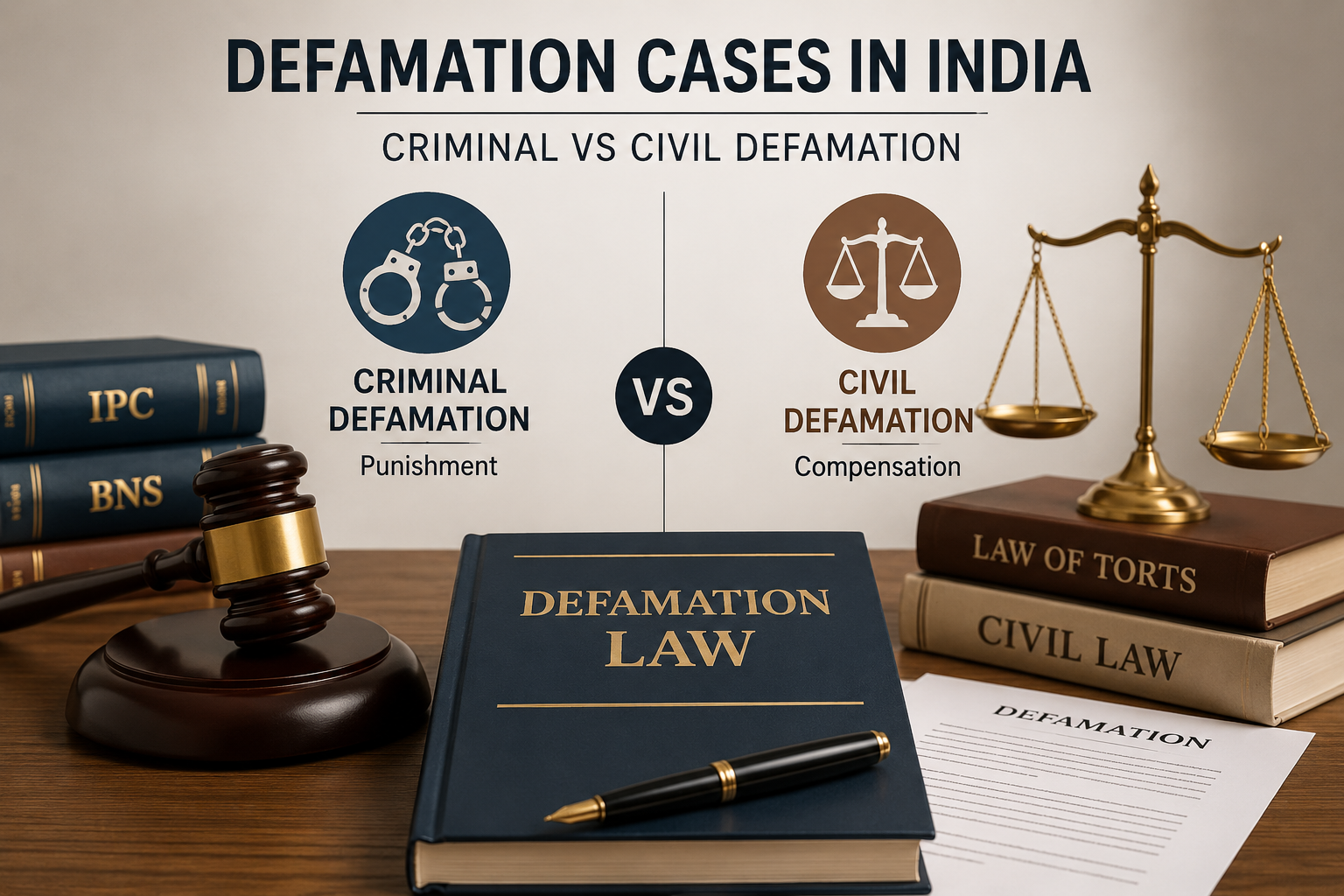
Criminal vs Civil Defamation: Major Differences
Criminal defamation and civil defamation differ in their legal nature, purpose, and consequences. Criminal defamation is treated as a criminal offence where the primary objective is to punish the accused for intentionally harming someone’s reputation. These cases are filed before criminal courts, and if the accused is found guilty, the court may impose a fine, imprisonment, or both. In criminal defamation matters, the burden of proof is generally higher because the complainant must establish that the defamatory statement was made knowingly or with malicious intent.
On the other hand, civil defamation is considered a civil wrong that mainly focuses on compensating the victim for reputational and financial damage. Such cases are filed before civil courts, where the aggrieved party may seek monetary compensation or injunctions against further publication of defamatory content. Compared to criminal cases, the burden of proof in civil defamation matters is relatively lower, as the primary focus is on proving damage to reputation rather than criminal intention. In some situations, both criminal and civil remedies may be pursued simultaneously depending on the facts and seriousness of the case.
Defamation Through Social Media
With the rise of digital platforms, online defamation cases in India have increased significantly. Defamatory content may appear on:
Instagram
Facebook
YouTube
X (Twitter)
LinkedIn
WhatsApp groups
Blogs and news portals
Online defamation can spread rapidly and cause serious reputational damage within hours. Courts in India now increasingly recognize digital evidence such as screenshots, URLs, emails, and chat records in defamation disputes.
Common examples include:
Fake allegations
Edited videos
False business reviews
Character assassination campaigns
Viral misinformation
Defamatory memes or posts
Defences Available in Defamation Cases
Indian law also recognizes several legal defences against defamation claims.
Truth
If the statement is true and made in public interest, it may not amount to defamation.
Fair Comment
Opinions expressed fairly on public matters may receive protection under law.
Privilege
Statements made during judicial proceedings or parliamentary discussions may enjoy legal privilege.
Good Faith
Statements made honestly for public benefit may sometimes qualify for protection.
However, these defences depend heavily on facts, evidence, and judicial interpretation.
How to File a Defamation Case in India
The legal process generally involves:
Collecting evidence of defamatory content
Identifying the publisher or accused person
Sending a legal notice
Filing a criminal complaint or civil suit
Presenting evidence before the court
Evidence may include:
Screenshots
Social media links
Emails
Video recordings
News articles
Witness statements
Timely legal action is important because online content can quickly spread or be deleted.
Importance of Legal Assistance in Defamation Matters
Defamation disputes often involve complex legal and technical issues, especially in digital and cyber-related matters. A legal professional can help with:
Drafting legal notices
Filing complaints
Seeking injunction orders
Protecting online reputation
Handling media-related disputes
Representing clients before courts
Professional legal guidance becomes even more important in high-profile, business, political, or cyber defamation matters.
Conclusion
Defamation law in India aims to balance freedom of speech with the protection of individual reputation. Both criminal and civil defamation provide important legal remedies against false and damaging statements.
While criminal defamation focuses on punishment, civil defamation mainly seeks financial compensation and reputation restoration. With increasing online activity and digital communication, defamation disputes are becoming more common across social media and business environments.
Anyone facing reputational harm should act quickly, preserve evidence, and seek proper legal guidance to protect their rights under Indian law.