
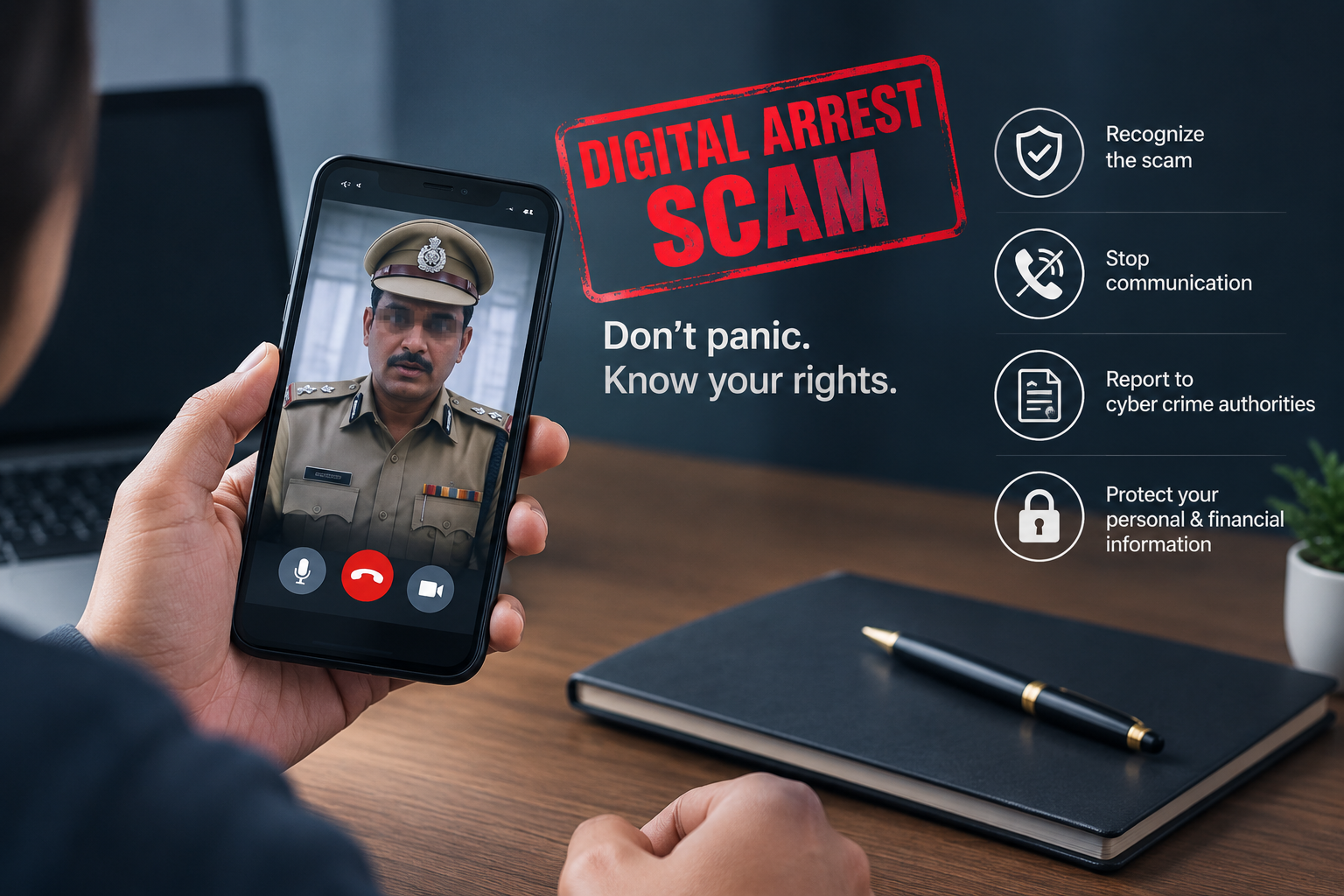
Digital scams in India are becoming increasingly sophisticated, and one of the most alarming forms is the digital arrest scam. In these scams, fraudsters impersonate police officers, government officials, or representatives of agencies such as the CBI, RBI, Enforcement Directorate or other authorities. They then threaten victims with arrest or legal action and demand money or sensitive information.
The Indian Cyber Crime Coordination Centre (I4C) has specifically warned about such scams and clarified that there is no concept of “digital arrest” under Indian law.
Understanding how these scams operate and knowing what legal steps to take can help victims respond quickly and protect themselves.
What Is a Digital Arrest Scam?
A digital arrest scam is a type of cyber fraud in which criminals falsely claim that a person is involved in a criminal case. The scam may begin with a phone call, WhatsApp message, video call, email or other online communication.
The fraudster may claim that the victim's Aadhaar details, mobile number, bank account or identity documents have been connected to illegal activities. They may also falsely allege involvement in money laundering, drugs, fake documents or other offences.
The victim is then threatened with immediate arrest unless they cooperate or pay money.
According to the I4C advisory, scammers may keep victims on video calls for extended periods and create fake police-station settings to make their claims appear genuine.
How Does a Digital Arrest Scam Work?
Digital arrest scams generally follow a pattern:
Initial contact: The victim receives a call or message from someone claiming to be a government or law-enforcement official.
False allegations: The scammer claims that the victim is connected to an illegal transaction or criminal investigation.
Intimidation: The victim is threatened with arrest, account freezing or other legal consequences.
Fake verification: The victim may be transferred to another supposed official through a phone or video call.
Demand for money: The scammer asks for money as a security deposit, verification payment, settlement amount or other fabricated charge.
Continued pressure: Criminals may keep communicating with the victim until money or personal information is obtained.
The use of official-looking documents, uniforms, agency names and video calls can make these scams particularly convincing.
Is Digital Arrest Legal in India?
No. “Digital arrest” is not a legal form of arrest in India. The I4C's March 2025 advisory expressly states that there is no concept of digital arrest under Indian law.
A person should therefore be extremely cautious if someone claims that they have been placed under “digital arrest” and must remain on a video call or transfer money to avoid physical arrest.
Legitimate law-enforcement procedures should not be confused with demands made by unknown individuals over phone calls or messaging applications.
What Should You Do If You Become a Victim?
If you have transferred money or shared sensitive information with a suspected scammer, acting quickly is important.
1. Stop communicating with the scammer
Do not continue the video call or follow further instructions. Do not transfer additional money simply because the scammer threatens you with arrest or legal action.
2. Report the financial fraud immediately
For cyber financial fraud, the National Cyber Crime Reporting Portal advises victims to call 1930, the national cybercrime helpline. Complaints can also be submitted through the official National Cyber Crime Reporting Portal.
Prompt reporting can help authorities take appropriate steps regarding the fraudulent transaction.
3. Preserve evidence
Keep screenshots, phone numbers, WhatsApp messages, emails, recordings where lawfully available, transaction details, bank statements and copies of documents sent to the scammers.
Do not delete potentially relevant communications before preserving them.
4. Contact your bank or financial institution
If money has been transferred, immediately inform your bank or relevant payment service provider and explain that the transaction resulted from suspected cyber fraud.
5. Consider legal assistance
Depending on the circumstances, victims may need legal assistance for dealing with cybercrime authorities, financial institutions or subsequent legal proceedings. A lawyer can help assess the available remedies based on the specific facts of the case.
How to Protect Yourself From Digital Arrest Scams
Prevention is one of the most effective ways to avoid becoming a victim. Government advisories recommend not sharing sensitive personal or financial information with unidentified callers.
Keep these precautions in mind:
Do not share OTPs, PINs, passwords or banking credentials.
Do not transfer money because someone threatens you with arrest.
Verify the identity of anyone claiming to represent a government agency.
Avoid installing unknown applications sent through suspicious links.
Do not share copies of identity or financial documents without proper verification.
Save evidence of suspicious calls and messages.
Report suspected cyber fraud as soon as possible.
The RBI has also warned about fraudsters impersonating government and RBI officials and using threats involving account blocking, suspicious transactions and alleged illegal activities to obtain personal and financial information.
Conclusion
A digital arrest scam in India is a serious form of cyber fraud that relies on fear, impersonation and urgency. Fraudsters may use the names and identities of government or law-enforcement agencies to make false allegations and pressure victims into transferring money or revealing sensitive information.
Remember that there is no legal concept of digital arrest in India. If you receive such a threat, do not panic or make payments simply because a caller claims to be an official. Preserve the evidence, contact your bank if money has been transferred, and report the incident through the appropriate cybercrime channels, including 1930 and the National Cyber Crime Reporting Portal.
For complex situations involving financial loss, criminal allegations or subsequent legal proceedings, obtaining advice from a qualified legal professional can help you understand the appropriate course of action.