
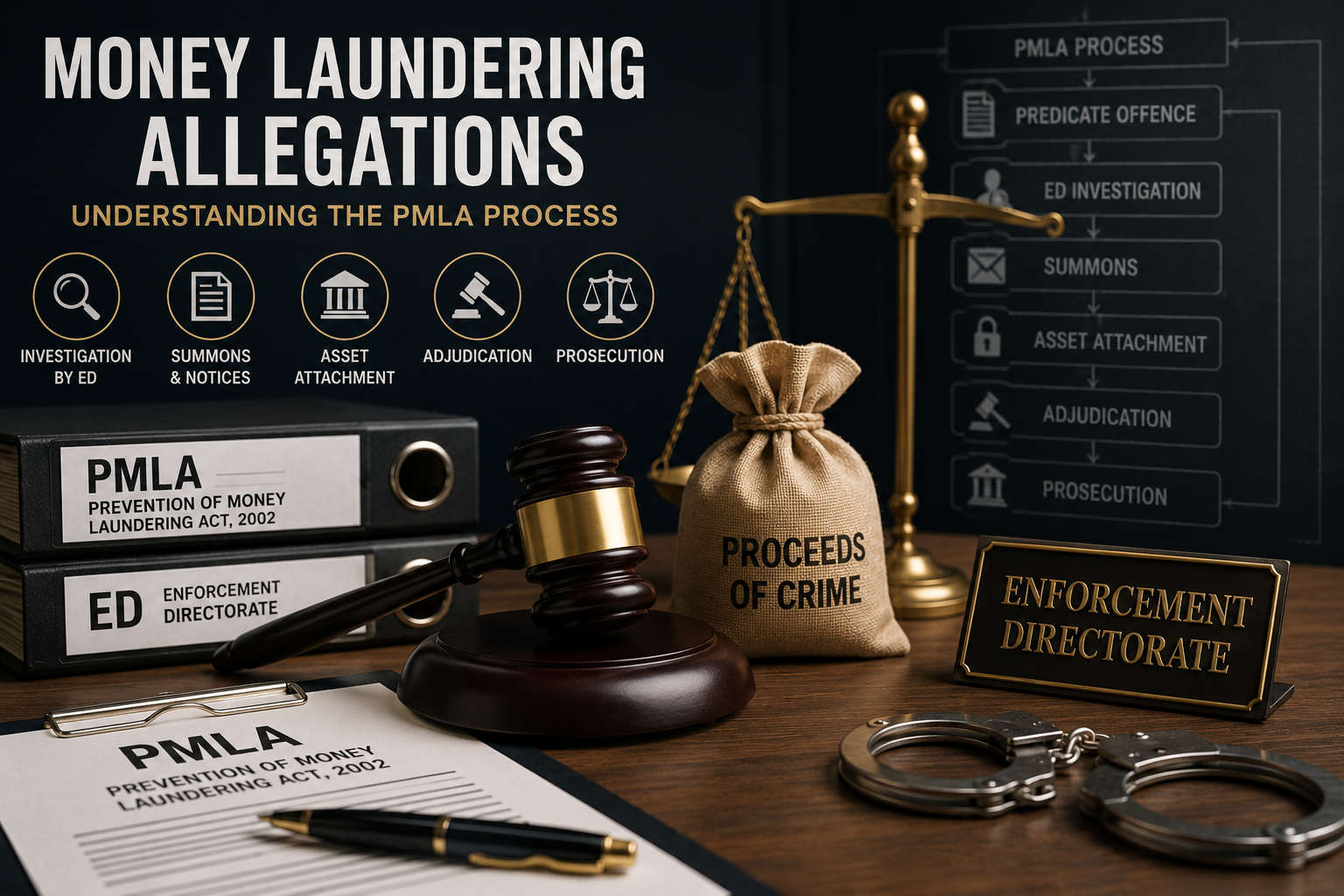
Money laundering investigations have become increasingly common in India as authorities strengthen efforts to combat financial crimes, fraud, corruption, and illegal financial activities. The primary legislation governing such cases is the Prevention of Money Laundering Act, 2002 (PMLA), which empowers authorities to investigate, attach, and confiscate assets linked to proceeds of crime.
Being accused of money laundering can have serious legal, financial, and reputational consequences. Whether you are a business owner, investor, company director, or individual, understanding the PMLA process is essential for protecting your rights and responding appropriately to an investigation.
What Is Money Laundering?
Money laundering refers to the process of concealing the origin of illegally obtained funds and making them appear legitimate. It typically involves multiple transactions designed to disguise the source of money generated through criminal activities.
Common predicate offences linked to money laundering include:
Fraud and financial scams
Corruption and bribery
Cybercrime offences
Tax evasion
Ponzi and MLM schemes
Drug trafficking
Cryptocurrency-related fraud
Corporate financial misconduct
Under Indian law, if funds are considered "proceeds of crime," any attempt to possess, transfer, conceal, or use those funds may attract liability under the PMLA.
What Is the Prevention of Money Laundering Act (PMLA)?
The Prevention of Money Laundering Act, 2002 is a special law enacted to prevent money laundering and enable authorities to identify, investigate, and confiscate assets derived from criminal activities.
The law is primarily enforced by the Enforcement Directorate (ED), which investigates offences involving proceeds of crime and financial misconduct.
The objectives of the PMLA include:
Preventing money laundering activities
Tracking illegal financial transactions
Attaching proceeds of crime
Confiscating unlawfully acquired assets
Prosecuting individuals involved in money laundering
How Does a PMLA Investigation Begin?
A PMLA investigation usually does not begin independently. It is generally triggered by a scheduled offence, also known as a predicate offence.
Examples include:
Cyber fraud investigations
Corruption cases
Large-scale financial scams
Criminal breach of trust
Corporate fraud allegations
Once a predicate offence is registered by a law enforcement agency, the Enforcement Directorate may initiate a separate investigation under the PMLA if it believes proceeds of crime are involved.
Stages of the PMLA Process
Understanding the stages of a PMLA investigation can help individuals prepare for legal proceedings.
1. Registration of Predicate Offence
The process usually begins when another agency registers an FIR, complaint, or criminal case involving a scheduled offence listed under the PMLA.
The Enforcement Directorate may then examine whether proceeds of crime have been generated from the alleged offence.
2. Enforcement Directorate Investigation
The ED gathers evidence by reviewing:
Bank account transactions
Property ownership records
Corporate documents
Financial statements
Digital communications
Cryptocurrency transactions
Investigators may issue notices requiring individuals to appear for questioning or submit documents relevant to the investigation.
3. Summons Under PMLA
The Enforcement Directorate has the authority to issue summons requiring a person to:
Appear before investigating officers
Provide information
Submit financial records
Answer questions related to transactions
Ignoring an ED summons can result in legal complications, making it essential to seek legal advice immediately upon receiving one.
4. Provisional Attachment of Assets
If authorities believe certain assets are linked to proceeds of crime, they may provisionally attach:
Bank accounts
Real estate
Investments
Vehicles
Business assets
Digital assets and cryptocurrencies
Asset attachment can significantly impact businesses and individuals, making prompt legal action critical.
5. Adjudicating Authority Proceedings
After provisional attachment, the matter is reviewed by the Adjudicating Authority established under the PMLA.
The affected individual or entity is given an opportunity to present evidence and challenge the attachment order.
6. Prosecution Complaint
If sufficient evidence exists, the Enforcement Directorate may file a prosecution complaint before a Special PMLA Court.
The court then examines the allegations and determines whether charges should proceed to trial.
Rights of Individuals Facing PMLA Investigations
Although PMLA investigations are serious, individuals retain important legal rights throughout the process.
These include:
Right to legal representation
Right to challenge asset attachment
Right to present evidence
Right to fair legal proceedings
Right to seek bail where applicable
Right to challenge unlawful actions through courts
Understanding and exercising these rights can significantly affect the outcome of a case.
Common Mistakes to Avoid During a PMLA Investigation
Many individuals unintentionally harm their legal position by making avoidable mistakes.
Some common errors include:
Ignoring Summons
Failure to respond to ED notices can create additional legal complications.
Providing Incomplete Information
Incomplete disclosures may raise further suspicion and prolong investigations.
Destroying Documents
Attempting to alter or destroy records can lead to serious consequences.
Delaying Legal Advice
Early legal guidance often helps identify risks and formulate an effective response strategy.
How Businesses Can Reduce PMLA Risks
Businesses can take proactive steps to minimize exposure to money laundering allegations.
Recommended practices include:
Conducting customer due diligence
Maintaining accurate financial records
Implementing anti-money laundering compliance procedures
Monitoring unusual transactions
Performing vendor verification checks
Ensuring regulatory compliance
Strong compliance systems can help prevent investigations and demonstrate good faith during regulatory scrutiny.
Why Legal Representation Matters
PMLA proceedings involve complex legal and financial issues that require specialized expertise. From responding to ED summons and challenging asset attachments to defending allegations before courts, experienced legal representation plays a crucial role in protecting an individual's rights.
A knowledgeable lawyer can assess the facts, identify procedural irregularities, prepare documentation, and guide clients through every stage of the investigation.
Conclusion
Money laundering allegations can have far reaching consequences for individuals, professionals, and businesses. The Prevention of Money Laundering Act gives authorities significant powers to investigate financial activities, attach assets, and prosecute alleged offenders.
Understanding how the PMLA process works, knowing your legal rights, and obtaining timely legal assistance can make a substantial difference when facing an investigation. If you receive an ED summons, face asset attachment proceedings, or become involved in a money laundering inquiry, seeking professional legal guidance at the earliest opportunity is essential to protecting your interests and ensuring compliance with the law.