
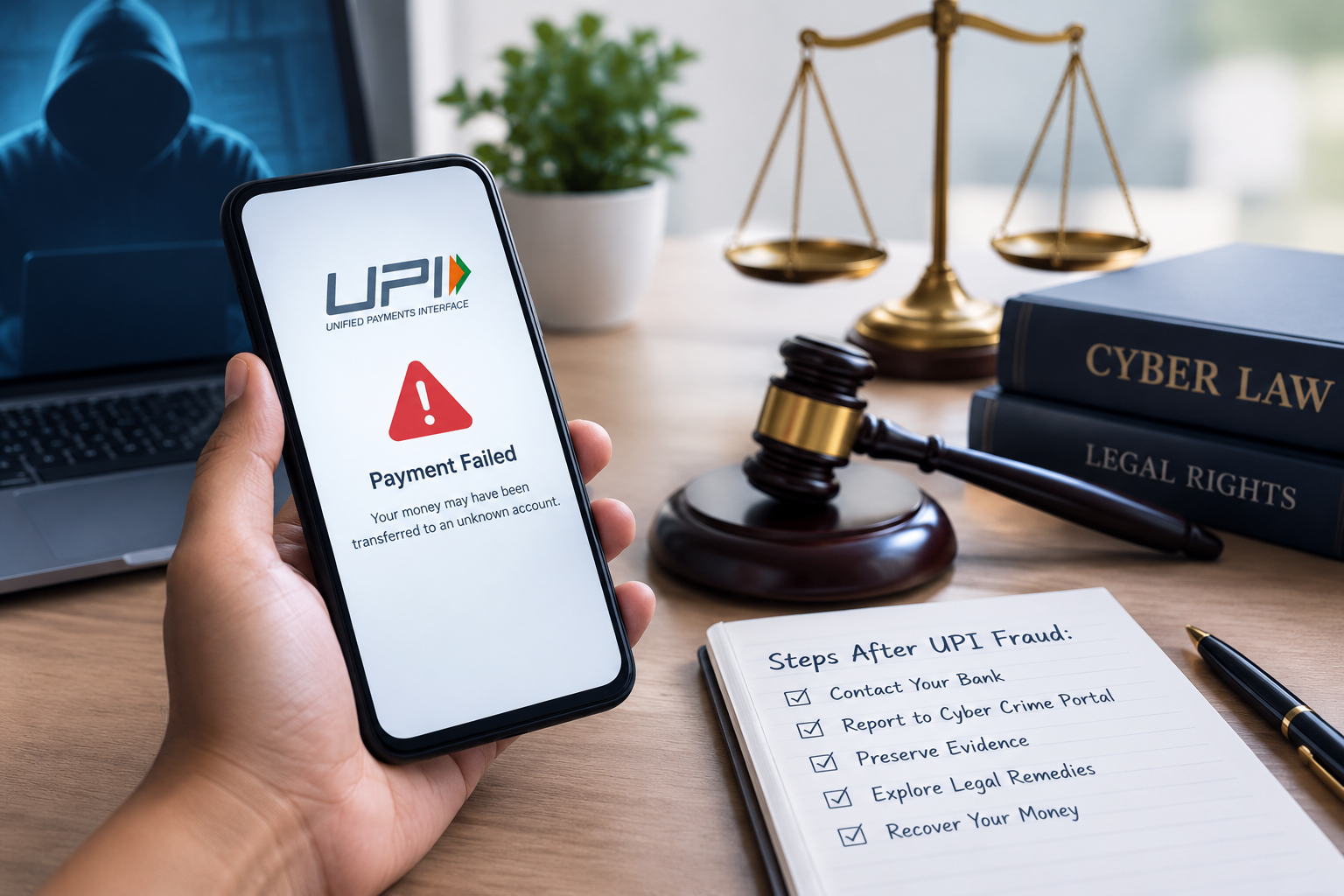
Unified Payments Interface (UPI) has made digital payments quick and convenient across India. However, the growing use of UPI has also led to an increase in online payment fraud. Fraudsters may use fake payment requests, phishing links, impersonation, screen-sharing applications, fake customer-care numbers, or social engineering techniques to trick people into transferring money.
If you have lost money through a fraudulent UPI transaction, acting quickly is important. Understanding the available UPI fraud legal action can help you report the incident, preserve evidence, and explore possible recovery options.
What Is UPI Fraud?
UPI fraud occurs when a person is deceived or manipulated into making an unauthorized or fraudulent digital payment through a UPI-enabled application. Unlike ordinary payment mistakes, UPI fraud generally involves deception, impersonation, unauthorized access, or other dishonest methods.
Common examples include:
Fake UPI payment requests
QR-code payment scams
Phishing links sent through SMS, email, or messaging apps
Fake bank or customer-care representatives
Fraudulent refund or cashback offers
Screen-sharing or remote-access scams
Social media and online shopping scams
Fake investment or loan schemes involving UPI payments
The exact legal consequences depend on the circumstances of the fraud and the evidence available.
What Should You Do After UPI Fraud?
The first few hours after a fraudulent transaction can be important. If you discover that money has been transferred through a fraudulent UPI transaction, take immediate steps instead of waiting to see whether the money returns automatically.
1. Contact Your Bank Immediately
Inform your bank or payment service provider about the fraudulent transaction. Ask them to record the complaint and take appropriate steps to secure your account and, where possible, prevent further movement of the funds.
Keep the transaction ID, date, time, amount, UPI ID and other payment details available when making the complaint.
2. Report the Fraud to the Cyber Crime Authorities
Victims can report financial cyber fraud through India's official cyber crime reporting system. Providing complete transaction details can help authorities understand the incident and investigate the flow of funds.
If the fraud is recent, immediate reporting can be particularly important because authorities may have a better opportunity to trace or potentially restrict the transferred funds.
3. Preserve All Evidence
Do not delete messages, emails, call records, screenshots, payment confirmations, or other communications with the suspected fraudster.
Important evidence may include:
UPI transaction IDs
Bank statements
Screenshots of payment confirmations
Fraudster's phone number or UPI ID
WhatsApp or SMS conversations
Email communications
Website or social-media account details
Call recordings, where lawfully available
Details of the incident and timeline
This information may become relevant during the investigation or any subsequent legal proceedings.
What Legal Action Can Be Taken for UPI Fraud?
The appropriate UPI fraud legal action depends on how the fraud was committed and the facts of the case. Cyber fraud may involve offences under India's applicable criminal and information-technology laws.
Depending on the circumstances, victims may pursue remedies through the cyber crime authorities, police, banking channels, and appropriate legal proceedings.
A lawyer can review the transaction, communications, and other evidence to determine which legal remedies may be appropriate. Where necessary, legal assistance can also help with communication with authorities and pursuing recovery-related proceedings.
Can You Recover Money Lost Through UPI Fraud?
Recovery is not always guaranteed, but victims should not assume that the money is automatically lost.
The possibility of recovery can depend on several factors, including:
How quickly the fraud was reported
Whether the funds can be traced
Whether the recipient account still contains the money
The nature of the fraudulent transaction
Banking records and transaction evidence
Cooperation of relevant financial institutions
Progress of the investigation
Court or other legal directions, where required
Therefore, delaying the complaint can make the recovery process more difficult.
What If the Bank Does Not Resolve the Complaint?
If your complaint is not adequately resolved through the bank or payment service provider, additional grievance and legal remedies may be available depending on the circumstances.
A victim should maintain copies of all complaints, acknowledgment numbers, emails, transaction records, and responses received from the bank or relevant authorities. These records can help demonstrate that the fraud was reported and what steps were taken afterward.
If significant money is involved or the matter becomes legally complicated, consulting a lawyer experienced in cyber and financial fraud matters can help identify the appropriate next step.
How Can You Protect Yourself From UPI Fraud?
Prevention is one of the most effective ways to reduce the risk of UPI fraud. Remember that receiving money generally does not require entering your UPI PIN. Your UPI PIN should only be entered when you are intentionally authorizing a payment.
You should also:
Never share your UPI PIN or OTP with anyone.
Avoid clicking suspicious payment links.
Verify the recipient before making a payment.
Do not install unknown remote-access applications at another person's request.
Use official bank and payment-app customer-support channels.
Be cautious of unexpected cashback, refund, investment, or prize offers.
Check transaction details carefully before entering your UPI PIN.
Conclusion
UPI fraud can cause significant financial loss, but victims have legal and complaint mechanisms available to them. The most important steps are to report the fraudulent transaction quickly, notify the bank, preserve evidence, and seek appropriate legal assistance when necessary.
If you are dealing with a UPI fraud case, understanding your available UPI fraud legal action options can help you take informed steps toward investigation and possible recovery. Each case is different, so the appropriate legal remedy should be determined after reviewing the specific facts and evidence.